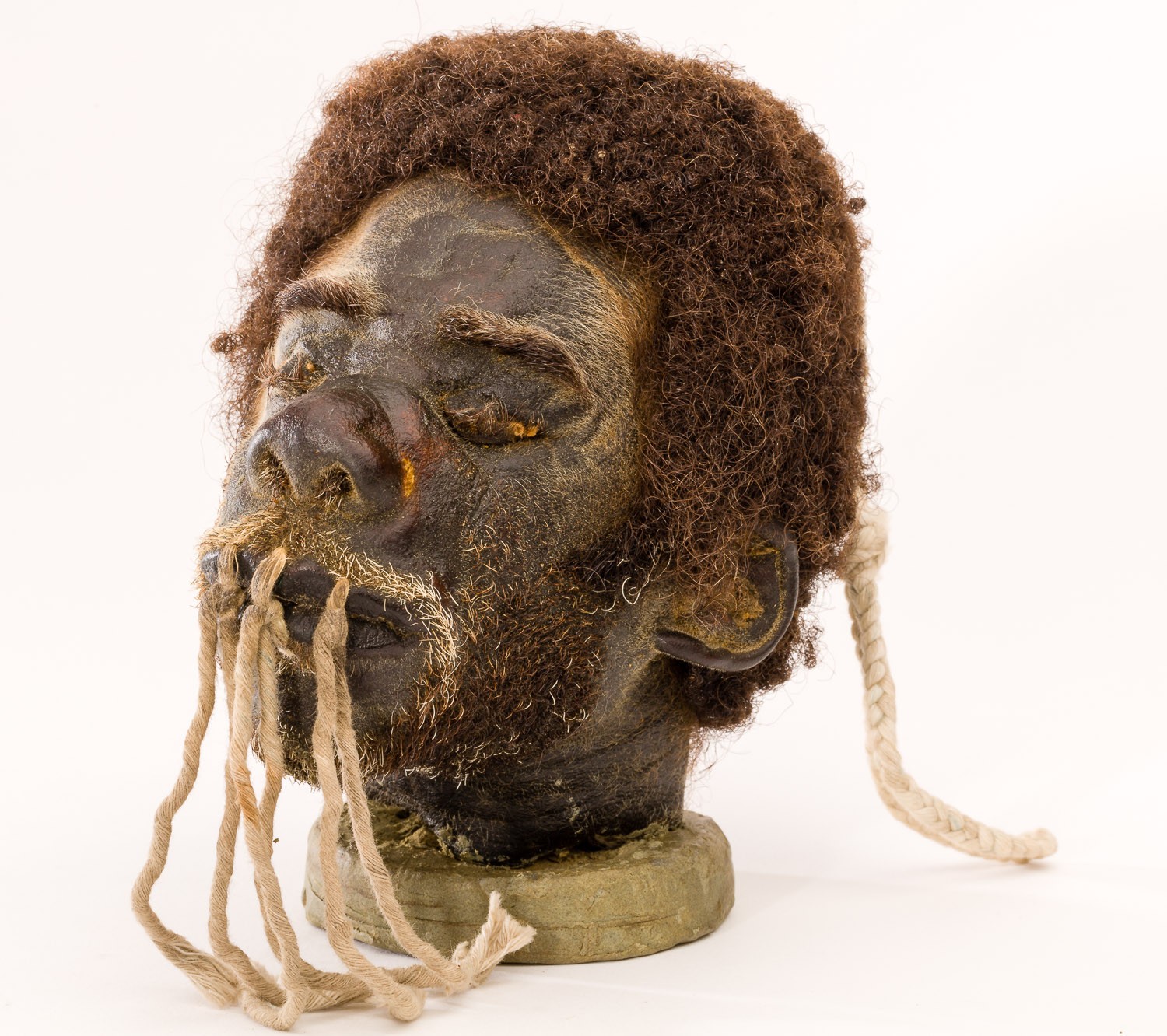
Shrunken head
Human remains and plant fibres; undated and of unknown origin.
A shrunken head is a trophy unlike any other. It does not commemorate an achievement or gain the favour of any spirit or ancestor as an amulet might. It is fascinating not only because of its exoticism, but also because of the way in which it is made, which, while poorly understood or over-embellished, can seem repulsive. Its status is ambiguous. It is a static, possibly decorative, artefact that is removed from its original functions. It comes from an individual – a human being – and must therefore be treated with respect. Originally, shrinking heads was practised by the Jivaro culture in the Amazon. Incidentally, the term ‘Jivaro’ is rejected and very poorly received by natives, since it is of Spanish origin and means ‘savages’ or ‘barbarians’. Shrinking heads is linked to a form of warfare among the Jivaro people: war between tribes. Its aim is to appropriate the power of other tribes, in order to ensure the prosperity and fertility of one’s own. The ritual of shrinking heads aims to capture the identities of people outside the tribe, that is, enemies who are captured and decapitated. Capturing made it possible to create new identities within the tribe itself. These new identities are represented by future children. As a result, head shrinking links death to fertility and procreation.
The shrunken head kept in Jehay was never used in a ritual context and is one of hundreds – perhaps thousands – of heads that were produced in America and transported overseas to adorn the homes of Western collectors. Furthermore, its abundant capillary pattern and the texture of the hair serve as a clear link to sub-Saharan Africa. The head, therefore, was made from the remains of a slave or a slave descendant. Until it was abolished in 1888, slavery in Brazil resulted in the displacement of several million people of African origin. Once they were free of slavery, Africans, their descendants and mixed-raced people, who were then called ‘Mulattos’, were still looked down on as citizens. Poverty, exploitation and exclusion were part of their everyday existence. As a result, the shrunken head kept in Jehay tells a complex and horrific tale.